Travel is one of life's great escapes. A chance to step away from routines, responsibilities, and the constant demands on our attention. Yet most of us take our inboxes, group chats, social feeds, and endless notifications with us wherever we go. We sit in beautiful places while staring at the same screens we look at every day.
The irony is that the technology designed to make life easier often makes it harder to switch off. That's why a growing number of travellers are increasingly looking for destinations with little or no internet access. Welcome to the world of digital detox travel, which has moved well beyond wellness-retreat marketing jargon into something approaching genuine cultural appetite.
And yes, there's a special kind of luxury in being unreachable. Genuinely, properly, nobody-can-get-hold-of-you, unreachable. Just you and your destination with no inbox to distract you, no group calls in the middle of the trip, and definitely no doomscrolling at midnight.
In this article, we'll look at the destinations where being unreachable isn't a failure of infrastructure but a feature of it. They also happen to be among the best places to use Avios reward seats.
Why No Wi-Fi Has Become a Selling Point
From the moment we wake up until we go to sleep, every second of every day of our lives is so connected that it would've seemed science fiction twenty years ago.
Hotels have treated fast Wi-Fi as a core amenity for years, up there with hot water and air conditioning. And while most still do, certain corners of the travel industry are increasingly providing spaces for individuals who feel the need to break the hold our devices have on us. Connectivity, it turns out, is not always what people want from a holiday. What they're now starting to realise they want is its absence.
And granted it's not for everyone, at least not all at once. The first evening without a connection can feel strange. It's like an itch you can't scratch. You find yourself reaching for your phone to check something, only to come up empty. But researchers who've studied digital detox retreats consistently report the same pattern: the itchiness passes within about 48 hours, time slows down, and people start noticing things they'd stopped noticing. The sound of footsteps on gravel, the different aromas wafting in through the window, the sights and colours that become clearer.
Without screens, families find themselves in the same moment. Couples talk more. Meals last longer as food tastes better, becoming an experience rather than just fuel. Travel feels slower and more memorable because you stop documenting it and start experiencing it.
This is why many no-Wi-Fi destinations are physically removed from normal life: safari lodges in remote conservancies, mountain trails above the snowline, and eco-camps in desert canyons. It's because the absence of a signal amplifies the sense of distance from everything familiar.
The destinations that follow all qualify as off-grid experiences and are reachable from London with British Airways Avios. If you've been looking for a reason to use British Airways Avios on something genuinely worthwhile, a trip designed around switching off entirely is a strong candidate.
Kenya: The Masai Mara and Beyond
Best for: Wildlife, wilderness, and the kind of silence that's difficult to find anywhere else
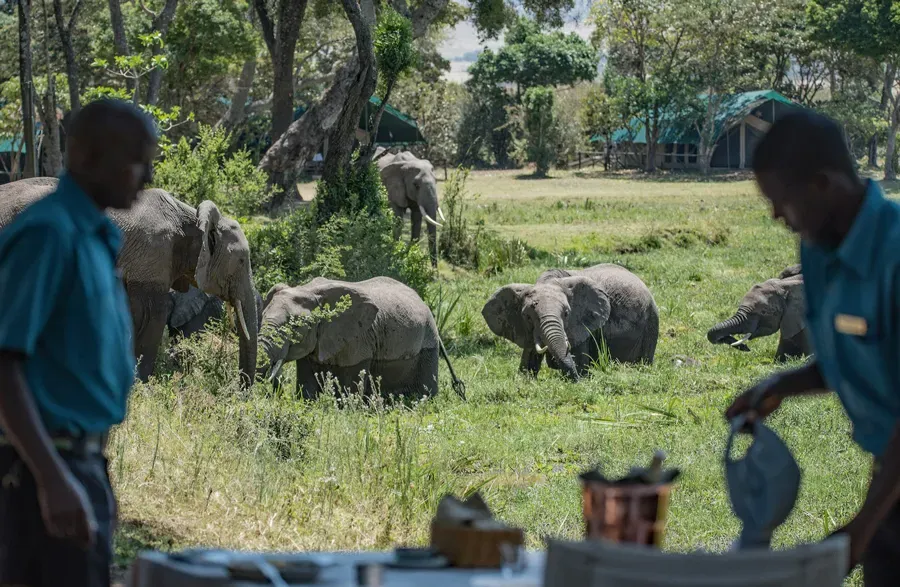
Kenya should be the poster child for no-Wi-Fi destinations. It's so spoilt for choice in terms of the terrain and the wildlife that even so much as glancing down at one's phone feels like a criminal offence. No wonder, then, that in the private conservancies surrounding the Masai Mara National Reserve, many of the most celebrated safari camps don't offer it at all, sometimes not even on site.
Camps like Serian, which operates across multiple locations in the Mara and intentionally keeps all of them offline, have built their entire philosophy around the idea that a safari is a rare opportunity to be present within a system that has no interest in entertaining you. The multi-sensory experience of being in the bush, they argue, is easily disrupted the moment someone pulls out a phone to share it with someone who isn't there.
It's a persuasive position, especially once you're sitting in a game vehicle at sunrise watching a cheetah move through the long grass. Whether or not you agree with the philosophy in theory, in practice, you tend to discover that the absence of a connection is the least interesting thing about your morning.
Where to go:
- Masai Mara National Reserve and private conservancies: Remote camps in the private conservancies (Olare Motorogi, Naboisho, Mara North) frequently have no in-tent Wi-Fi and limited or no communal connectivity. Game drives at sunrise and sunset, evenings by the fire, and the best wildlife photography light in Africa. The Great Migration passes through from July to October.
- Laikipia County: Ultra-remote conservancy lodges here often have patchy satellite Wi-Fi at best, and some intentionally minimise connectivity to preserve the wilderness experience. More rugged and less visited than the Mara.
- Samburu National Reserve: More remote than the Mara, with a distinctive and drier landscape. Many camps operate only on a weak or intermittent signal. One of the better places for travellers who want true escapism alongside exceptional wildlife.
- Northern Kenya and the Turkana region: This calls for genuinely expedition-style travel rather than traditional holidaymaking. Infrastructure is sparse outside the towns, and the internet is essentially nonexistent. Not for the faint-hearted, but for travellers who want to feel truly removed from the modern world, it delivers that in full.
- Lamu Island: A different register entirely with no cars in much of the old town, a relaxed pace borrowed from centuries of Swahili maritime culture, and boutique stays that keep connectivity minimal by design.
- Chyulu Hills: Boutique safari lodges that encourage stars, silence, and disconnection. Connectivity is weak or restricted, and the landscape, volcanic hills above the plains, with Kilimanjaro visible on a clear day, is extraordinary.


 British Airways
An off-peak Premium Economy return from London to Nairobi costs 104,500 Avios plus £400 per person, or 198,000 Avios plus £499 in Business Class. If you're booking Business Class, use the Club Suite Filter on Reward Flight Finder to make sure you're on one of BA's newest aircraft rather than the older cabin product. On a near-nine-hour overnight flight, the difference matters.
Montana, USA
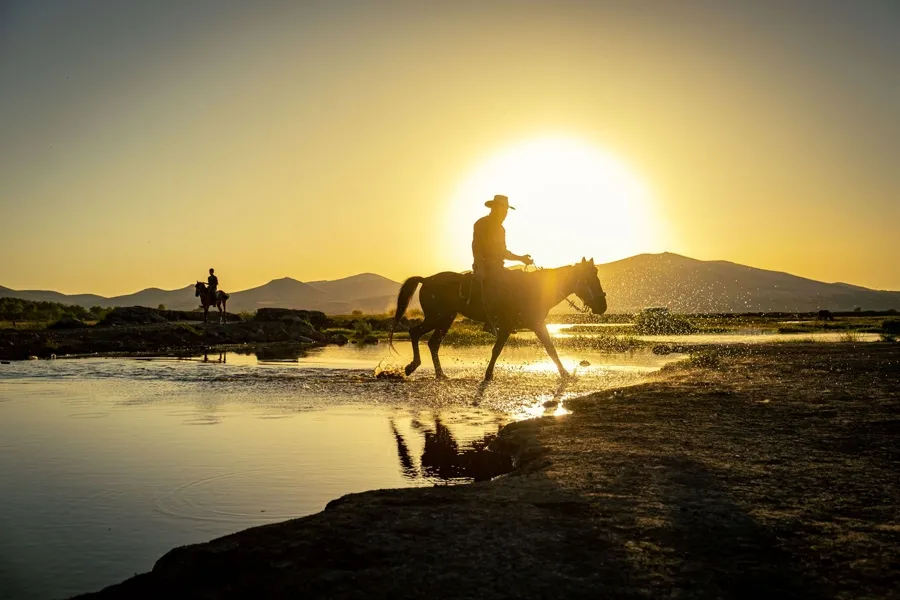
Best for: Big landscapes, genuine off-grid stays, and doing absolutely nothing at scale
Home to more than 3,000 named lakes, including Flathead Lake, and reservoirs, Montana is the argument that America still has places large enough to make you feel small. The state covers nearly 380,000 square kilometres (an area larger than Germany), and cell signal and Wi-Fi are unreliable in its remotest reaches. For most of the state, the landscape still hasn't changed significantly since Lewis and Clark came through in 1804.
Montana works so well as a digital detox destination because its scale actively encourages slowness. There's no sense of rushing between attractions, because the attractions are the landscape itself: mountains, wildlife, rivers, enormous skies. Ranches in the Ruby Valley or around Paradise Valley near Yellowstone frequently market limited connectivity as a feature.
Some working ranches have no reliable signal at all. The itinerary involves horseback riding, fly-fishing, campfires, and, if you're at the American Prairie Reserve in central Montana, watching bison move across a shortgrass prairie that looks almost exactly as it did two hundred years ago.
Where to go:
- American Prairie Reserve: A nonprofit-managed reserve spanning over three million acres of the northern Great Plains. Limited cell coverage almost everywhere except the edge of the reserve. Stay in solar-powered yurts along the Judith or Missouri rivers. Bison, pronghorn, meadowlarks, and a night sky without light pollution.
- Glacier National Park: Explore 700 miles of trails, historic lodges built in the early twentieth century, with extremely limited Wi-Fi and cell connectivity outside the gateway towns. The Going-to-the-Sun Road is fifty miles of mountain driving through some of the most dramatic scenery in North America.
- Remote ranch stays (Ruby Valley, Paradise Valley, Bridger Mountains): Montana guest ranches arguably represent the ultimate log-off trip. Many working ranches have no reliable phone signal. The activities, horseback riding, cattle drives, fly-fishing, and campfire evenings, are all structured around the premise that you have nowhere else to be.
- Big Sky and Flathead Lake: Go beyond the main resort area, and you'll find mountain cabins, wilderness lodges, and lakefront stays that deliberately keep technology to a minimum. Think books on porches and paddleboards at dusk instead of screens.
 British Airways
There's no direct BA flight to Montana, so you'll need to connect via Denver. An off-peak Premium Economy return from London to Denver costs 104,500 Avios plus £400 per person, or 198,000 Avios plus £499 in Business Class, with a domestic connection of around ninety minutes onward to Montana.
Use the Club Suite Filter on Reward Flight Finder to identify Club Suite-equipped aircraft on the transatlantic leg, and as with all reward seats, the best time to book Avios reward seats is as early as possible, with availability opening 355 days before departure.
Jordan: The Wadi Dana Trail
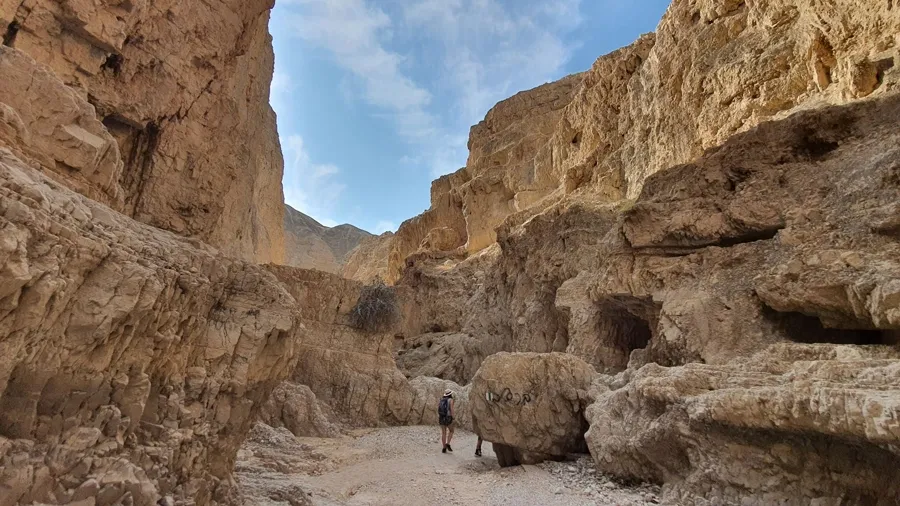
Best for: Hiking, slow travel, and canyon landscapes that look borrowed from another planet
Yes, there's more to Jordan than Petra. While Wi-Fi can tell you everything about everything, it can't answer the question you don't ask. For that, you need to switch off your devices and find answers the old-fashioned way. And the Wadi Dana Trail is just the route for you with its sixteen kilometres of canyon, cliff, and desert, running from the fifteenth-century Ottoman village of Dana down through the Dana Biosphere Reserve to the celebrated Feynan Eco-Lodge in Wadi Araba.
Jordan's largest nature reserve, the Biosphere, covers more than 300 square kilometres and sustains four distinct ecosystems: Mediterranean, Irano-Turanian, Saharo-Arabian, and Sudanian. There are 45 species of mammal here, over 200 bird species, and more than 800 plant species. Most hikers complete the trail in five to seven hours, descending through increasingly dramatic scenery toward the eco-lodge, which runs entirely on solar power and candles after dark.
 British Airways
Wi-Fi along the trail is weak to nonexistent. Connectivity is limited to communal areas at best in the eco-lodges and camps at either end, and some stays have none at all. The landscape makes a strong case for your full attention.
Where to go:
- Wadi Dana Trail: Sixteen kilometres descending from the Ottoman village of Dana through the canyon to the solar-powered Feynan Eco-Lodge. No in-room connectivity along the route; communal-only at best at either end. Complete in a day or stay overnight at the lodge.
- Dana Biosphere Reserve: The broader reserve surrounding the trail, with additional hiking routes requiring a mandatory guide to protect the ecosystem. The Royal Society for the Conservation of Nature runs the Dana Guesthouse at the trailhead.
- Wadi Rum: The obvious pairing. Desert camps here operate by candlelight and campfire, with essentially no connectivity outside the gateway town. The landscape, red sandstone, vast silence, absurdly starry skies, is one of the best arguments for leaving your phone in a drawer.
- The Dead Sea: The lowest point on Earth and one of the most surreal landscapes in the Middle East. Boutique stays along the Jordanian shore tend to be quiet, unhurried, and blissfully light on connectivity. Float, read, and do very little.
- Petra: Of course, no trip to Jordan can be complete without it, or nobody will believe you went to Jordan. The ancient Nabataean city is carved into rose-red sandstone cliffs. Connectivity inside the archaeological site is patchy. Arrive early, stay late, and let the scale of the place do its work.
Most travellers pair the Wadi Dana Trail with Petra, Wadi Rum, and Amman, making for an exceptional seven-to-ten-day itinerary that moves through several of the most visually arresting landscapes in the Middle East. Wadi Rum, for what it's worth, has essentially no connectivity outside its gateway town. The desert camps there operate by campfire and silence.
An off-peak Economy return from London to Amman costs 30,000 Avios plus £102 per person, which makes Jordan one of the better-value Avios reward flight destinations on this list, and one of the more unexpectedly rich options for travellers who want to switch off properly.
Iceland: The Laugavegur Trail
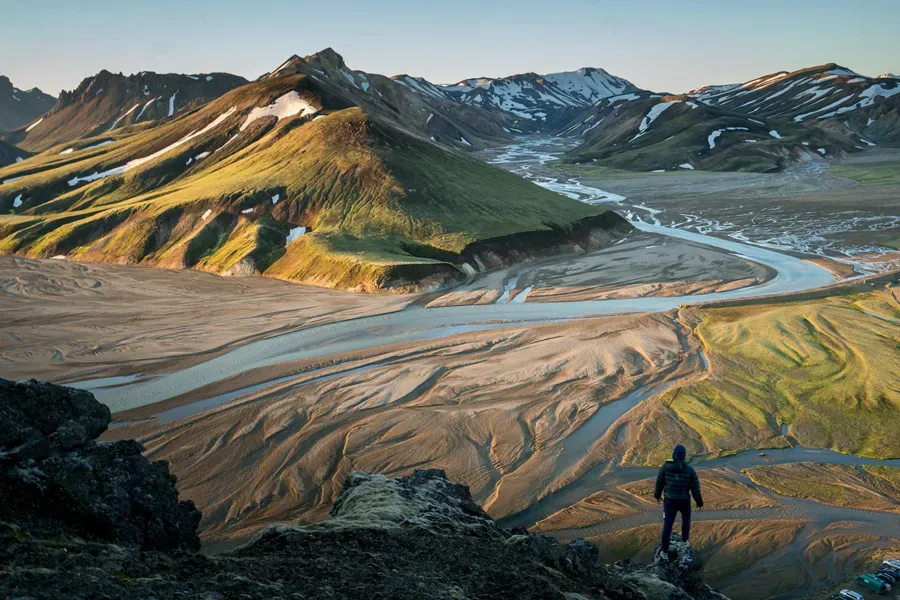
Best for: Adventure hiking, volcanic landscapes, and the specific satisfaction of being completely, structurally offline
While the Land of Fire and Ice is chock-a-block with stunning terrain that should make you forget your phone exists, Iceland's Laugavegur Trail is 55 kilometres of the most visually improbable hiking terrain in the world. National Geographic has named it one of the most beautiful long-distance trails on Earth, and it's one of those occasions where the reputation isn't exaggerated.
The trail runs from Landmannalaugar, a geothermal wonderland of hot springs and rhyolite mountains painted in shades of red, pink, and green, south through the Highlands to the glacial valley of Þórsmörk. In between, you'll find black lava fields, ash deserts, steaming geothermal valleys, and glacial river crossings.
Mobile signal is weak or nonexistent along most of the trail. The mountain huts that dot the route (bookable through the Iceland Touring Association, and essential to reserve well in advance for the summer season) prioritise basics over connectivity.
This is not a resort escape. It's boots-on, backpack-on, fully switched-off travel. Most people complete it in four to six days, moving between huts and campsites, and the days become surprisingly simple: walk, eat, sleep, repeat. The absence of anything to check is its own kind of luxury.
Where to go:
- Landmannalaugar to Þórsmörk (the full Laugavegur Trail): It may be hard to pronounce but it's the classic four-to-six-day route through the Southern Highlands. Book mountain huts through the Iceland Touring Association well in advance; the trail is open June to mid-September.
- Fimmvörðuáls extension: Many hikers continue from Þórsmörk over the Fimmvörðuáls pass to Skógafoss waterfall on the south coast, adding roughly two more days and some of the most dramatic volcanic terrain on the trail.
- Reykjavík: The natural base before and after the trail. Fully connected, full of good restaurants and geothermal pools, and a useful reminder of what you've been happily avoiding for the past week.
- South coast pairings: The Golden Circle, Jökulsárlón glacier lagoon, and the black sand beaches at Reynisfjara all sit within range for the days either side of the hike, rounding out a seven-to-ten-day Iceland itinerary that moves between extremes.
 British Airways
Most travellers pair the trail with Reykjavík, the Blue Lagoon, the Golden Circle, and the south coast waterfalls and black beaches, making a seven-to-ten-day Iceland itinerary that combines wilderness with rather easier creature comforts. The Laugavegur is best hiked between June and mid-September, when the mountain huts are staffed, and the route is snow-free.
An off-peak Economy return from London to Reykjavík costs 30,000 Avios plus £102 per person, one of the best-value Avios reward flights available, for a destination that consistently ranks among the most extraordinary on Earth.
If you're working out which of these destinations suits your current points balance, our Avios calculator will show you exactly how far your points stretch across routes and cabin classes.